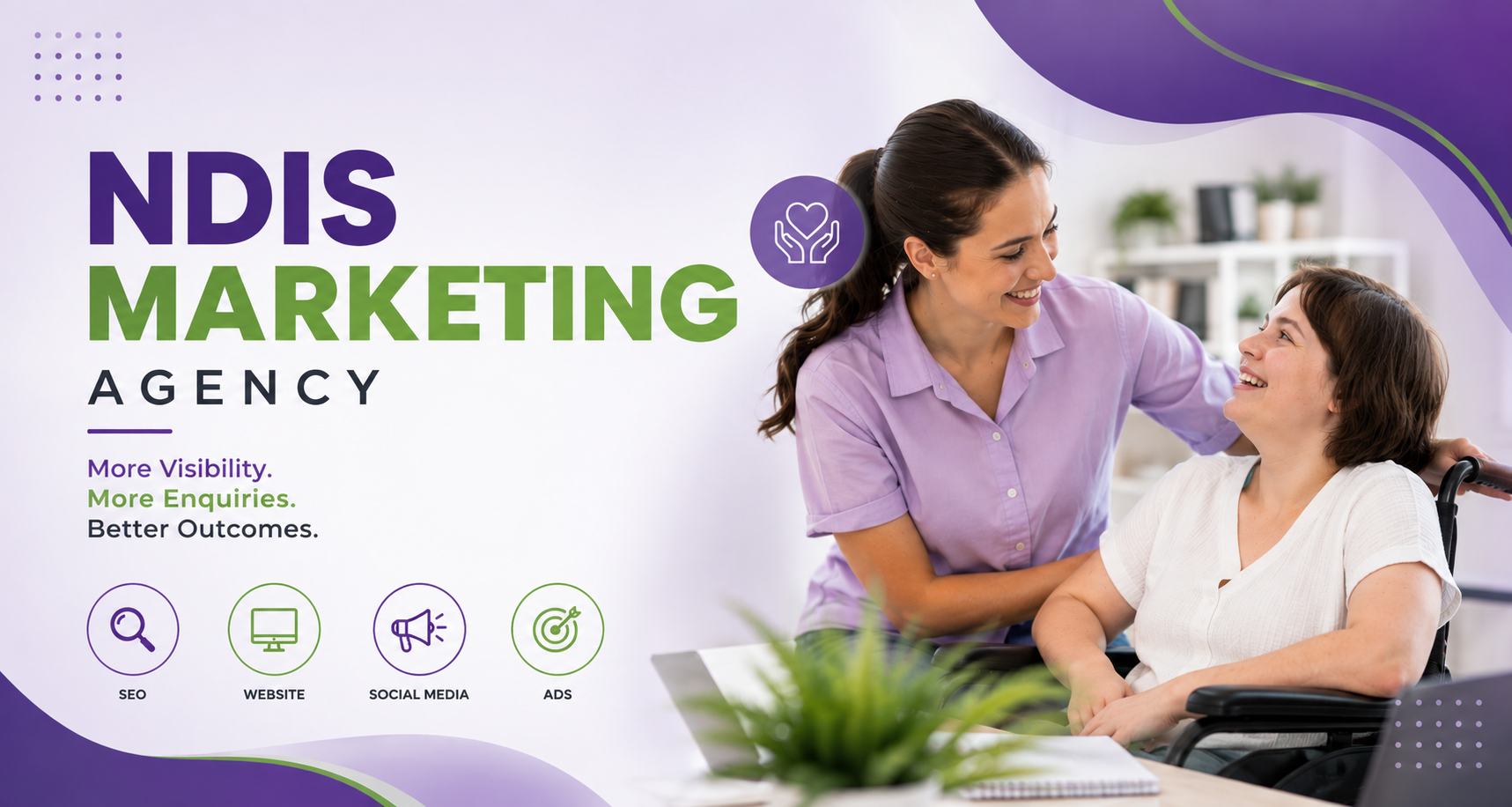
Choosing the right NDIS Marketing Agency can make a significant difference to how an NDIS provider is discovered, understood and trusted online.
The NDIS sector continues to become more competitive. As a result, simply having a website or social media account is no longer enough. Providers need a clear digital strategy that connects their website, search visibility, content, social media and other marketing channels.
More importantly, NDIS marketing should be designed around the people who matter most to your organisation. Participants, families, support coordinators and referral partners may all look for information in different ways.
A well-planned marketing strategy brings these opportunities together and helps your business build a stronger presence over time.

What Is an NDIS Marketing Agency?
An NDIS Marketing Agency specialises in helping disability service providers promote their services and improve their visibility.
Unlike a general marketing company, an agency working with NDIS providers needs to understand the specific audience, terminology, service structure and communication requirements of the sector.
Depending on the provider’s goals, an NDIS marketing strategy may include:
- Search engine optimisation
- Website design and optimisation
- Google Business Profile optimisation
- Google Ads
- Social media marketing
- Content marketing
- Local SEO
- Brand development
- Online reputation management
- Lead generation
- Conversion optimisation
The purpose is not simply to make a provider appear online. Instead, effective marketing should help potential clients understand the organisation and take the next step when they are ready.
Why NDIS Providers Need Specialist Marketing
Marketing an NDIS provider is different from promoting a typical local business.
People are often researching services that can have a meaningful impact on their everyday lives. They may want to know whether a provider offers the right support, operates in their area and can meet their individual circumstances.
For this reason, trust and clarity are particularly important.
A specialist NDIS Marketing Agency can help providers create marketing that speaks to different audiences, including:
- NDIS participants
- Parents and family members
- Support coordinators
- Plan managers
- Allied health professionals
- Community organisations
- Other referral partners
Furthermore, a specialist approach can help keep the marketing message focused on genuine services rather than generic advertising language.
Build a Strong NDIS Digital Marketing Strategy
Effective NDIS digital marketing should not depend on one channel.
For example, SEO may bring someone to your website, while a detailed service page helps them understand your support. Social media can then reinforce brand awareness, and a clear contact process can turn interest into an enquiry.
Each channel should therefore support the others.
A strong digital strategy may combine:
SEO
Improve visibility for relevant NDIS services and locations.
Website Marketing
Create pages that explain services clearly and encourage enquiries.
Social Media
Build awareness and maintain regular communication with your audience.
Google Ads
Reach people searching for relevant services with high-intent queries.
Content Marketing
Answer questions and demonstrate knowledge through useful resources.
Local Marketing
Connect your organisation with people searching for support in specific locations.
This integrated approach can create a more consistent customer journey.
NDIS SEO: Get Found When People Are Searching
One of the most valuable services an NDIS Marketing Agency can provide is search engine optimisation.
People may search for a provider using a combination of service, location and support-related terms.
For example, searches might include:
- NDIS provider Sydney
- NDIS support services Melbourne
- NDIS disability support
- NDIS support worker
- NDIS community participation
- Supported independent living
- NDIS personal care
- Disability support services near me
The exact keywords should depend on your services and operating locations.
Rather than creating hundreds of pages for every possible keyword, a better strategy is to build useful pages around genuine search demand.
Service-Based SEO
Each important service can have its own dedicated page.
This gives visitors more information while allowing search engines to understand the purpose of the page.
Location-Based SEO
Providers that operate within specific suburbs or regions can create useful location content based on their actual service areas.
For example, a provider may target:
NDIS Support Services Parramatta
rather than attempting to rank for every Australian city.
Educational SEO Content
Blog articles and guides can answer common questions and attract people earlier in their decision-making process.
Over time, useful content can also strengthen the overall topical relevance of a website.
NDIS Website Marketing
Your website is often the most important asset in your digital marketing strategy.
However, a website should do more than look professional.
It should quickly answer three questions:
Who are you?
What support do you provide?
How can someone contact you?
A well-designed NDIS website should make this information easy to find.
Clear Service Information
Visitors should be able to understand what each service involves without reading complicated or overly technical content.
Strong Calls to Action
Contact options should be visible throughout the website.
Examples include:
- Make an Enquiry
- Contact Our Team
- Request More Information
- Discuss Your Support Needs
- Speak With Our Team
Mobile-Friendly Design
Potential participants and families may access your website using smartphones. Therefore, mobile usability should be considered from the beginning of the design process.
Fast Website Performance
Slow pages can create a poor user experience and may reduce the likelihood that visitors continue exploring your website.
For this reason, image optimisation, efficient hosting and clean website development are important parts of website marketing.
Local Marketing for NDIS Providers
For many providers, local visibility is more valuable than national exposure.
An NDIS organisation may only service particular suburbs, regions or states. Consequently, attracting website visitors from outside the service area may not create meaningful business opportunities.
A local marketing strategy can include:
- Google Business Profile optimisation
- Local keyword targeting
- Service-area pages
- Local citations
- Genuine customer reviews
- Community involvement
- Relevant local content
- Local backlinks
Google Business Profile is particularly useful because it can help eligible businesses appear in local search and map results.
However, local SEO should always reflect where your organisation genuinely operates.
Creating misleading location pages simply to target additional suburbs can reduce trust and create a poor experience for visitors.
NDIS Social Media Marketing
Social media can help providers stay visible and communicate their values.
However, successful NDIS social media marketing is not about posting promotional content every day.
A better strategy is to create different types of content.
Educational Posts
Answer common questions about NDIS services and disability support.
Team Stories
Introduce team members and explain their roles.
Community Content
Share suitable activities, events and community involvement.
Service Information
Explain your support services in simple, participant-focused language.
Helpful Resources
Direct followers to useful guides and information on your website.
Consistency matters more than posting large amounts of content for a short period.
As a result, an organised content calendar can make social media easier to manage while keeping communication consistent.

Google Ads for NDIS Providers
SEO can provide long-term visibility, but paid search can help businesses reach people more quickly.
Google Ads allows providers to target searches that are relevant to their services and locations.
For example, a campaign could focus on searches relating to:
- NDIS support services
- Disability support providers
- Supported independent living
- NDIS community support
- Local NDIS services
However, paid advertising should be carefully planned.
Sending every advertisement to the homepage is rarely the best approach. Instead, campaigns should ideally direct visitors to relevant landing pages that clearly explain the advertised service.
The landing page should then provide a simple and obvious next step.
Content Marketing for NDIS Providers
Content marketing is another effective way to build authority and organic visibility.
Potential topics include:
- How to choose an NDIS provider
- What questions should you ask an NDIS provider?
- Understanding community participation support
- How disability support can assist with daily activities
- What to consider when comparing NDIS providers
- How families can research disability support services
- Understanding different types of NDIS support
Good content should answer real questions.
It should not simply repeat keywords.
For example, an article targeting NDIS Provider Marketing should provide practical information about marketing rather than mentioning the keyword in every paragraph.
This approach creates a better experience for readers while also supporting natural SEO.
Build Trust Before Asking for an Enquiry
Trust is one of the most important elements of NDIS marketing.
Someone visiting your website may not be ready to contact you immediately. They may first want to understand who you are, what you offer and whether your organisation appears suitable.
Therefore, your website should provide useful trust signals.
These may include:
- Clear information about your organisation
- Professional team profiles
- Service information
- Areas you cover
- Genuine reviews
- Appropriate testimonials
- Frequently asked questions
- Useful educational resources
- Easy-to-find contact information
Most importantly, marketing claims should accurately represent your organisation.
Avoid exaggerated promises or statements that cannot be supported.
Measure What Your NDIS Marketing Agency Is Actually Achieving
Marketing reports should go beyond showing how many people visited your website.
The more useful question is:
Are the right people finding your business and taking meaningful action?
Important metrics can include:
- Organic traffic
- Keyword rankings
- Website enquiries
- Phone calls
- Contact form submissions
- Google Business Profile interactions
- Conversion rate
- Cost per lead
- Social media engagement
- Referral enquiries
For example, an increase in website traffic may initially look positive. However, if most visitors are outside your service area, the increase may have little commercial value.
Therefore, quality and relevance should be considered alongside traffic volume.
How to Choose an NDIS Marketing Agency
Choosing a marketing partner requires more than comparing monthly prices.
Before making a decision, consider the following factors.
NDIS Industry Experience
Ask whether the agency understands the NDIS sector and has experience working with disability service providers.
Marketing Services
Find out whether the agency can provide the services you actually need.
These may include SEO, website development, Google Ads, social media and content marketing.
Communication
Marketing works best when communication is clear and regular.
Ask how often you will receive updates and how campaign performance will be explained.
Reporting
A professional agency should provide meaningful reports rather than simply listing vanity metrics.
Strategy
Avoid agencies that immediately recommend a standard package without first understanding your business, audience, services and locations.
A good strategy should be tailored to your actual objectives.
NDIS Marketing Agency vs General Marketing Agency
A general digital marketing agency may have experience across many industries.
That experience can be valuable. However, NDIS providers often have a more specialised audience and communication environment.
A specialist NDIS Marketing Agency can focus its strategy around:
- Participant-focused communication
- Disability support services
- Local NDIS searches
- Referral relationships
- NDIS-specific website content
- Industry terminology
- Relevant audience behaviour
This does not automatically mean a specialist agency is the right choice for every provider.
Instead, look for an agency that can demonstrate a genuine understanding of your business and explain how its strategy will help you reach your specific goals.
A Practical NDIS Marketing Framework
A simple marketing framework can help providers understand where to begin.
Step 1: Define Your Audience
Identify the participants, families and referral partners you want to reach.
Step 2: Clarify Your Services
Make sure your website clearly communicates your main services and service areas.
Step 3: Improve Your Website
Create a professional, mobile-friendly website with strong service pages and clear enquiry pathways.
Step 4: Build Search Visibility
Develop an SEO strategy around relevant services, locations and informational topics.
Step 5: Strengthen Local Presence
Optimise your Google Business Profile and build genuine local relevance.
Step 6: Create Consistent Content
Use blogs and social media to answer questions and demonstrate expertise.
Step 7: Measure Enquiries
Track where your enquiries are coming from and use that information to improve future campaigns.
This process creates a foundation that can be expanded as your organisation grows.

Common NDIS Marketing Mistakes
Even a well-funded campaign can struggle if the fundamentals are overlooked.
Targeting Too Many Keywords
Trying to rank for every NDIS-related search can spread your resources too thin.
Instead, focus on keywords that match your actual services and locations.
Using Generic Content
Generic articles provide little value to participants or search engines.
Create content that answers specific questions and reflects your organisation’s real expertise.
Ignoring Local Search
If your organisation operates in selected locations, local SEO should be part of your strategy.
Sending All Traffic to the Homepage
Different campaigns should ideally lead to pages that match the visitor’s search intent.
Focusing Only on Traffic
Website visitors are useful, but enquiries and relevant conversions are more meaningful business outcomes.
Inconsistent Marketing
Stopping SEO, content or social media after a few weeks can make it difficult to build lasting momentum.
Marketing usually works best as an ongoing process.
Why an Integrated Strategy Matters
The strongest NDIS marketing campaigns connect multiple channels.
For example, an SEO article can attract organic visitors. That article can then be shared through social media. A related service page can provide additional information, while a clear enquiry form gives the visitor an easy way to contact the provider.
Similarly, Google Ads can generate immediate visibility while SEO builds longer-term organic traffic.
In other words, the website, content, search, social media and advertising should not operate as separate activities.
They should work together around the same business objectives.
Frequently Asked Questions
An NDIS Marketing Agency helps disability service providers improve their visibility, communicate their services and generate relevant enquiries through strategies such as SEO, website marketing, social media, content and paid advertising.
A specialist agency can develop a strategy based on your services, locations and target audiences. This may include improving your website, increasing search visibility, creating content and managing digital advertising.
Yes. SEO can help providers appear when potential participants, families and referral partners search for relevant services online. A strong strategy should focus on useful content, technical optimisation and relevant service and location keywords.
Google Ads can be useful when a provider wants to reach people actively searching for relevant services. However, campaigns should be carefully targeted and connected to relevant landing pages.
The cost varies according to the services required, competition, locations and campaign objectives. Some providers may start with SEO or website improvements, while others may require a broader combination of marketing services.
SEO is generally a long-term strategy. Results depend on factors such as competition, website quality, existing authority, content and location. Providers should evaluate progress over time rather than expecting instant results.
Look for relevant industry experience, clear communication, transparent reporting, a tailored strategy and an understanding of your specific services and target market.
Grow Your NDIS Business With a Clear Marketing Strategy
The right NDIS Marketing Agency can help turn a fragmented online presence into a coordinated marketing system.
Rather than relying on occasional social media posts or a basic website, providers can build a strategy that connects SEO, website design, local search, content, social media and paid advertising.
Most importantly, the strategy should focus on the people your organisation is trying to reach.
When potential participants, families and referral partners can easily find your business, understand your services and see clear reasons to get in touch, your digital presence becomes a much more valuable business asset.
A thoughtful NDIS marketing strategy does not happen overnight. However, with consistent execution, useful content and measurable goals, it can provide a strong foundation for long-term online growth.